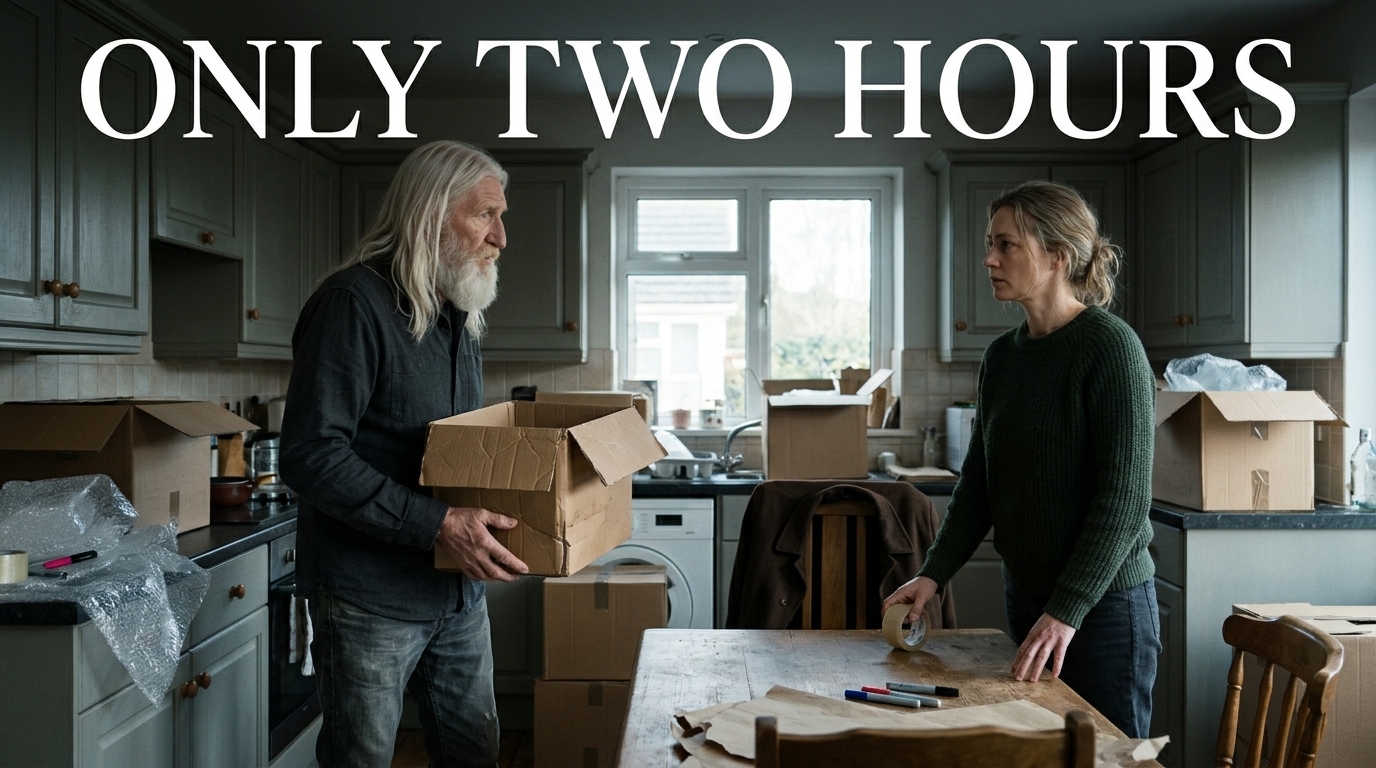
Part 3/3 — A Visit With an Ending
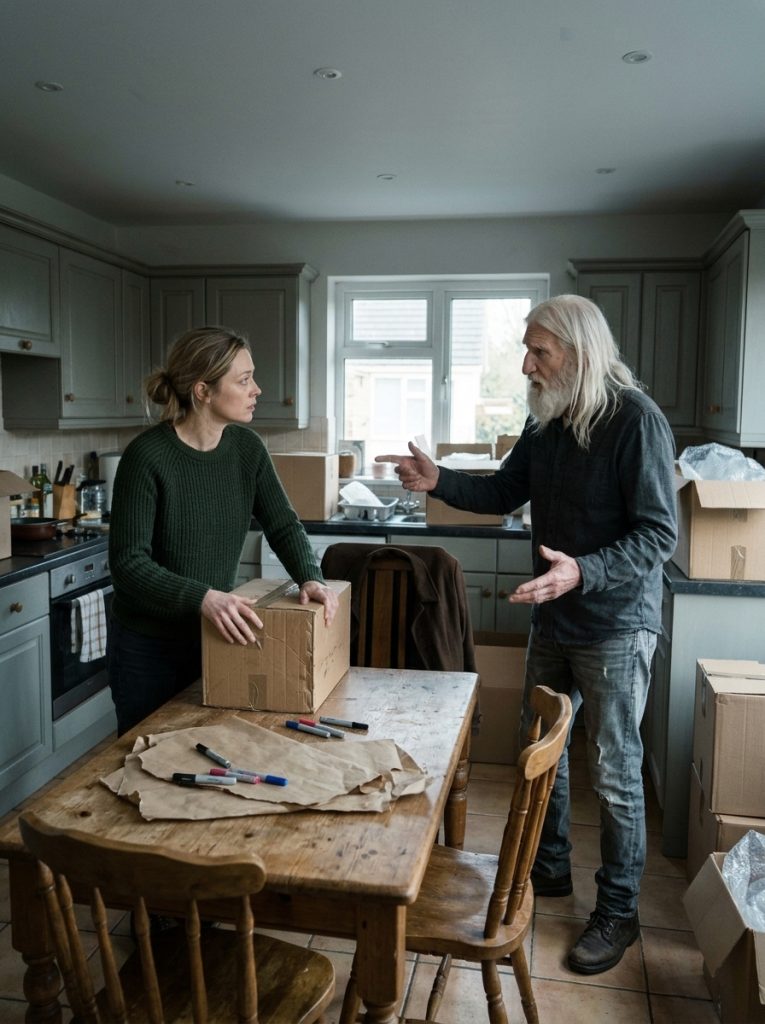
On Thursday, Ruth arrived in her work trousers with a loose button at one cuff. She looked at the cleared kitchen and then at the two mugs on the windowsill. Everything else had been packed.
“Are we drinking standing up?”
“The chairs are still available. Premium service.”
She sat. I boiled the kettle and measured the tea carefully, although I had made it for her hundreds of times. There were pale rectangles on the walls where photographs had hung. Without them, the room seemed less familiar than the flat I had visited only twice.
“I wanted to ask if you could come earlier tomorrow,” I said. “Before the van. I don’t want to close this place by myself.”
She rubbed the loose button between her fingers.
“I can’t leave work before eleven. We’ve got two people off, and nobody else can finish the wages.”
I nodded too quickly. We both saw it.
“I wish you could,” I said.
“I know.”
That was the entire answer. No accusation, no defence, no bargain in which she proved her love by making somebody else’s day harder.
It still hurt. I had thought asking plainly might make disappointment easier, and it didn’t, at least not immediately. But Ruth stayed in her chair. She wasn’t getting ready to escape me.
“Would tonight help?” she asked. “We could go through the rooms before I leave.”
Part of me wanted to refuse because it wasn’t what I had requested. That part had been making too many decisions lately.
“Yes,” I said. “I’d like that.”
We began in the little front room. I pointed to the dent in the skirting board where I had dropped an amplifier. Ruth remembered it as the place she crashed a borrowed skateboard.
“Two dents,” she said, crouching. “You’ve been blaming me for yours.”
“I’ve blamed you for several things. We may need a survey.”
She laughed, then stood and brushed dust from her knees.
In the room that used to be hers, she ran her hand along the windowsill. I asked what she remembered most. I expected birthday mornings or Jean helping with homework.
“Waiting to hear your van,” she said. “When you played out of town.”
I had worked days and played weekends when she was young. I thought of those years as effort made for the family. She remembered listening for an engine.
“I liked when you came in and checked on me,” she said. “Even when you smelled like chips.”
“I usually brought some.”
“Mum usually ate them.”
We smiled. Then Ruth looked toward the empty wardrobe.
“Sometimes you were here and still difficult to get near.”
My instinct was to list the hours I worked. The words were ready, well polished from use.
“I suppose I thought coming home was enough,” I said.
She didn’t soften what she had told me. I was glad later that she hadn’t. That night, I needed a moment before I could leave the room.
I wanted credit for staying, but I had to listen to what living with me had been like.
Downstairs, we drank the cold remains of our tea. Ruth asked whether I wanted something regular after the move. A walk, perhaps, on a Sunday afternoon when Ellie was studying.
“Every Sunday?” I asked.
“Let’s start with the first one. Then we can work out what’s realistic.”
I almost heard that as another reduction. Then I remembered all the grand arrangements that had collapsed beneath the weight I put on them.
We chose three o’clock. She entered it in her phone while I wrote it on the back of the removal invoice.
Before she left, I gave her the plastic folder containing the shelf measurements.
“Do you still need shelves?”
“Yes. But I want narrow ones. You kept drawing deep ones.”
“Narrow ones, then.”
“And don’t buy anything until I’ve measured.”
I agreed. She hugged me briefly in the hall. I didn’t hold on until the hug became a request.
The next morning, I woke before the alarm. I made tea, stripped the bed, and sat in the kitchen while daylight reached the window. At eight, my phone rang. It was Ruth, calling from the pavement outside her office.
“How are you doing?”
“Badly,” I said. “But I’ve found the kettle box.”
“That’s a start.”
We spoke for seven minutes. I didn’t use them to ask whether she could possibly get away early. When she said she had to go in, I thanked her for calling.
The removers arrived on time. Paying for their help turned out to be a sensible decision, particularly when one of them discovered that I had packed books in a box meant for cushions. He split the load without commenting on my optimism.
I carried the white serving dish myself. Everything else went into the van.
After the last room was checked, I stood inside the front door with the keys in my hand. I had expected the empty house to give me some final feeling that would make leaving possible. It smelled of dust and floor polish. A strip of wallpaper near the radiator had curled away from the wall.
I pressed it flat with my thumb, an entirely useless repair for a house I no longer owned. Then I went outside and locked the door.
At the flat, Ruth arrived at eleven carrying milk, bread, and a packet of biscuits. She found me arguing with a curtain pole.
“We’re already on bad terms,” I told her.
“Perhaps it needs some space.”
We unpacked the kitchen before touching anything else. The white dish fitted on the lower shelf. There was no room for all eleven spoons, so I kept three and let Ruth take two. The others went into the donation box without a ceremony.
At four, she left. I waved from the window, then washed our mugs. The flat was quiet, but there were fewer rooms for the quiet to fill.
The first Sunday walk was awkward. We spoke about parking, then bins, then a dog carrying a stick too wide for the path. Halfway around the park, Ruth told me about an interview for a better job. I asked whether she wanted advice or just wanted to tell me.
“Just tell you, for now.”
I managed that.
Not everything improved neatly. A fortnight later, she cancelled a visit because Ellie had a school meeting she had forgotten. I typed a bitter reply and erased it. Then I wrote that I was disappointed and asked about Thursday.
Thursday worked. Another week, it didn’t. I started having breakfast with Len on Wednesdays and took a regular afternoon shift sorting donated records at the charity shop. Neither arrangement replaced my daughter. They gave the rest of my week somewhere to go.
Missing her no longer had to be the only thing I did between visits.
In January, Ellie came for toast. Ruth brought the shelf measurements and stayed for coffee. I reached for a pencil to improve the drawing, caught myself, and asked where she wanted the first bracket.
Ellie examined the cooker, which was narrower than the old one. She asked whether I had mastered it yet.
“Mostly.”
“That sounds worrying.”
The grill began to smoke. We turned toward it together, and Ellie laughed before I did. I opened the window while Ruth scraped the black edge from a slice over the sink.
Ellie moved her plate aside and pulled up the empty chair with her foot.
“Sit down, Grandad. I’ll do the next lot.”
I sat while the bread was still warm.
What small, realistic way of keeping in touch has made a difference in your life?