An original fictional story inspired by the themes of ‘Before I Pass Away,’ told from the perspective of a fictionalized Michael Bennett.
Part 1/3 — The Echoes in the Empty Chair
The grandfather clock in the hallway of my home doesn’t just tick; it breathes. It is a steady, rhythmic respiration that fills the silence of a house that was built for four, lived in by two, and now barely contains the ghost of one. I sit in the same leather armchair in the corner of the living room, the one with the cracked left armrest where my thumb has compulsively rubbed the dark brown dye away over the years. From this vantage point, I have a perfect, unobstructed view of the front door. The brass handle, slightly tarnished from decades of hands turning it, catches the late afternoon sun, casting a long, slender shadow across the hardwood floor. I know the exact sound that door makes when it opens. It’s a heavy, reassuring thud, followed by a slight squeak from the bottom hinge that I never quite got around to oiling. When someone walks inside, I still look up, my heart doing that foolish, hopeful little skip. Just in case it’s him.
My phone vibrated on the side table, shattering the quiet. The sudden, mechanical buzzing against the wood made me jump. The screen illuminated the dimming room with a harsh, artificial glow, projecting notification banners into the twilight. I didn’t need to put on my reading glasses to know who it was, or what it said, but I put them on anyway, meticulously hooking the wire frames over my ears. The text was from my son, Julian.
“Dad, so sorry. Stuck at the firm again. The Miller merger is a nightmare. Can’t make it to dinner tonight. Let’s reschedule for next week? Promise I’ll make it up to you.”
I stared at the glowing letters until the screen timed out and went dark again. Next week. It was always next week. Or next month. Or after the holidays. You say you’ll come back soon. You say you’ve just been busy. You say you think about me. I try to believe you. I really do. But belief is a fragile thing when it is constantly battered by absence. I set the phone face down on the table, as if hiding the screen could erase the sting of the cancellation. It had been six months since Julian last walked through that front door, and even then, he had kept his coat on, constantly checking his watch, his mind already three steps ahead to his next appointment.
I pushed myself up from the armchair, my knees popping in loud protest. The house felt cavernous, every footstep echoing off the walls. Walking into the kitchen, I looked at the two place settings I had carefully arranged on the small oak table. The good porcelain plates. The silver forks. The cloth napkins folded into perfect squares. A pot of beef stew, Julian’s childhood favorite, was simmering on the stove, filling the air with the rich scent of rosemary, garlic, and root vegetables. It was a smell that belonged to a different era of my life, a time when this house was chaotic and loud, when my wife, Sarah, was still here, orchestrating our lives with a laugh that could cut through any foul mood.
I walked over to the stove and turned off the burner. The stew stopped bubbling, settling into a heavy, quiet stillness. Just like me. I didn’t want to be a burden to him. I knew his life was moving fast, faster than I could comprehend. He was a partner at thirty-five, building skyscrapers and reshaping the city’s skyline, while I was a retired carpenter whose greatest daily achievement was remembering to take my blood pressure medication on time. I told myself I was glad he was successful, that he was happy. I didn’t want to make him sad with my loneliness. So, I stayed quiet. I let it be. I told myself he remembered me, that I was still a part of his world, even if I was just a faded photograph on his office desk.
But days turn into tomorrow, and months turn into years. I realized I was learning how to live with what was not here, rather than living with what was. I was sixty-eight years old, and my life had been reduced to a waiting room. The walls of the house were lined with memories, framed behind glass, but there was no new life being made within them. I poured a cup of black coffee, the bitter taste a welcome distraction from the lump in my throat, and walked out the back door toward the detached garage.
The evening air was crisp, carrying the scent of damp earth and approaching autumn. The neighbor’s dog barked in the distance, a reminder that the world was still turning outside my property line. The garage was my sanctuary, a place of wood shavings, motor oil, and the tangible results of hard labor. But lately, it had become just another tomb. I walked past my neatly organized workbench, past the table saw I hadn’t turned on in a year, and stopped in front of the massive shape taking up the center bay. It was covered in a heavy, gray canvas tarp, gathering a thick layer of dust.
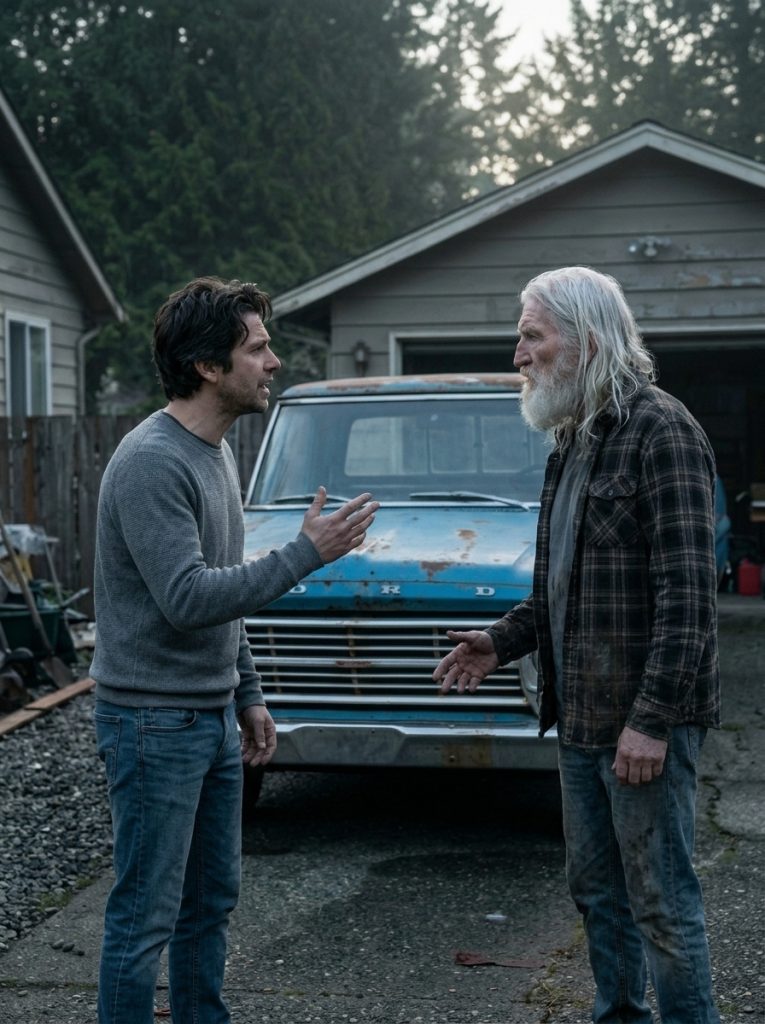
I reached out, grabbing a fistful of the rough fabric, and pulled. The tarp slid off with a heavy whisper, revealing the faded, rust-speckled, grabber-blue paint of a 1968 Ford F-100 pickup truck.
Julian and I had bought it together when he was fifteen. It was supposed to be our project. We were going to rebuild the engine, sand down the rust, paint it a deep cherry red, and drive it across the country the summer before he left for college. We had grand plans, fueled by greasy pizza and late nights listening to classic rock on the garage radio. We tore the engine down to the block that first year. We ordered parts, argued about carburetor sizes, and laughed until our sides hurt when a rogue spring launched across the room and hit me in the forehead.
Then, Sarah got sick. The cancer was aggressive, a sudden, violent storm that tore through our lives, leaving nothing but wreckage in its wake. The truck project stopped. The garage doors were closed. The tools were put away. And after Sarah died, Julian went to college on the opposite coast, throwing himself into his studies, into his career, into anything that wasn’t this house and the ghosts it held.
I stood staring at the truck. The engine bay was still half-empty, a gaping hole of unfinished promises. The tires were flat, the chrome was pitted and peeling. It was a monument to a future we never got to have. I realized, with a sudden, suffocating clarity, that I had been waiting for Julian to come back not just to eat dinner, but to finish this truck. To finish our story. I had thought there would always be time. I had thought the years stretching ahead of us were infinite. But love doesn’t just wait in the dark. Love shows up. And Julian wasn’t showing up.
A quiet, desperate anger began to simmer in my chest. It wasn’t a loud, explosive anger, but a deep, sorrowful one. Not meaning to hurt me still hurt. After I pass away, would he stand by my grave and cry for the time he never gave? Would he look at my headstone and wish he had called, wished he had come, wished he had simply said my name instead of sending a text message? I was here. I was alive. I didn’t need much. Just a little time. Just to feel that I was still on his mind before it was too late. Before the clock in the hallway stopped ticking for me.
I couldn’t do it anymore. I couldn’t sit in that chair and watch the door handle, praying for it to turn. I couldn’t let this truck sit here as a hollow symbol of my waiting. The garage smelled like old gasoline and despair, and I was choking on it. If the past was truly dead to him, then I needed to bury it. I needed to move on, even if it meant moving on without him.
I pulled my phone out of my pocket, the same device that had delivered his cancellation minutes earlier. I opened the camera, wiped the dust off the lens with my thumb, and started taking pictures of the truck. I took photos from every angle. The rusted quarter panels, the torn vinyl bench seat with springs poking through, the scattered boxes of engine parts sitting on the concrete floor. I walked back into the house, sat down at the kitchen table with my cold coffee, and opened a local online marketplace on my laptop.
I didn’t think about the consequences, or how Julian might feel. I just typed out the description: 1968 Ford F-100. Project car. Needs work. Make an offer.
I hit publish. The listing went live immediately. For the first time in years, I had done something other than wait. But as I closed the laptop, the silence of the house pressed in on me heavier than ever, whispering that I had just struck a match near a powder keg, and there was absolutely no turning back.
⬇️ CLICK Page 2 to Read Part 2 ⬇️